The first hard frost of the season changes the questions people ask about an outdoor cold plunge. In summer the problem is keeping the water cold enough. From November on, the problem flips: how do you keep the tub, the lines and the chiller from freezing, and is it still safe to get in when there is ice on the surface?
Quick answer: an outdoor plunge survives winter on three things. Keep the water covered with an insulated, strapped-down lid. Keep it moving, because circulating water freezes far more slowly than still water. And if your chiller has a heating mode and is rated for the conditions you get, let it hold a minimum temperature. If you can’t do all three, or you’re heading into a long stretch well below freezing, draining and winterizing the equipment is usually cheaper than replacing a cracked chiller.
Why outdoor plunges freeze (and what actually breaks)
Water in a tub loses heat through the surface fastest, so a skin of ice usually forms on top first, often overnight when the air is still. A thin surface skin on the tub itself is mostly an inconvenience. The expensive damage happens elsewhere:
- Chiller internals and hoses. Water left sitting inside a chiller’s heat exchanger, pump or hoses has very little mass and freezes quickly. Ice expands as it forms, which can split fittings, crack pump housings and damage the exchanger. This is the most common reason manufacturers tell you to drain equipment before winter storage.
- Filters and plumbing fittings. Canister housings and quick-connect fittings trap small pockets of water that freeze before the main tub does.
- Thin or inflatable tub walls. Ice pushing against the sides of a rigid tub is usually a minor issue, but sharp ice edges, or chipping at ice with a tool, can puncture or scratch soft liners and inflatable walls.
- The ground around the tub. Splash water freezes into a slick sheet right where you step in and out, which is a real injury risk.
Chillers also have a built-in floor. Most are designed with a minimum set-point in the high 30s Fahrenheit so they can’t freeze the water themselves, which we covered in our cold plunge chiller buying guide. Winter freezing comes from the air, not the chiller.
Your five freeze-protection options, compared
| Method | How it helps | Best for | Main limitation |
|---|---|---|---|
| Insulated hard cover, strapped down | Cuts heat loss through the surface and keeps snow and debris out | Every outdoor tub, with or without a chiller | Doesn’t stop freezing on its own in long, very cold stretches |
| Keep water circulating | Moving water is much slower to freeze than still water | Tubs with a pump or chiller that runs on a schedule | Needs power; a power cut on a cold night removes the protection |
| Chiller with a heating mode | Can hold a minimum water temperature as well as chill | Plungers who want year-round outdoor use | Heat-pump heating weakens as air temperature drops; check the listed limits |
| Drain and winterize the equipment | Removes the water that can freeze and crack components | Long hard-freeze periods, vacations, or units not rated for cold | No outdoor plunging until spring unless you run a chiller-free ice routine |
| Move the tub to a garage or covered space | Takes wind and the coldest air out of the equation | Portable and inflatable tubs | Needs floor space, drainage and a GFCI-protected outlet |
Heat-and-cool chillers: what the specs say about winter
A growing number of cold plunge chillers can also heat. In heating mode they work as a heat pump, pulling heat from the outdoor air, and that matters in winter: when the outdoor air gets very cold, there is less heat to pull from it, so heating output drops. The better listings say so plainly. Here is what four current options publish, based on the specs and listing details, not hands-on use.
AURGOD Cedar Cold Plunge Tub with 1HP Chill-and-Heat Chiller
This is a complete outdoor-capable system: a Canadian red cedar tub with a stainless steel interior and a raised stainless base, shipped with a 1HP chiller and a waterproof leather lid. The listing gives tub dimensions of 51 x 36 x 28 inches and a temperature range of 37°F to 107°F, and says the 120V chiller is ETL-certified and takes about 3 to 4 hours to cool to 40°F.
What makes it useful for this guide is the listing’s own cold-weather note: heating efficiency drops a little when the air is 40°F or below, it falls off sooner in humid climates, and in freezing conditions of 25°F and below the tub may not reach your set temperature. The listing also says the chiller is not designed for use below 5°F, because its lubricating oil may freeze and seize the machine.

- Canadian Red Cedar Material: This wood round ice plunge tub is made of Canadian Red Cedar Wood. It is sturdy and durable, gets mor…
- Broad Space: Our Ice bath tub with built-in stainless steel base size is 51"W x36"D x28"H. With an at-home cold plunge tub, you ca…
- Installation and Shipping:The ice plunge and ice chiller are shipped as a complete set; no installation is required—simply connect…
BEYOND MARINA 1HP Hot and Cold Chiller
A standalone 1HP chiller with a cooling capacity of 2,405W and a heating capacity of 3,600W, according to the listing, plus ozone, dual filtration, a built-in pump and Wi-Fi control. It carries an IPX4 splash rating and is listed for indoor and outdoor use. The listing gives cooling times of about 2.7 hours for 53 gallons and under 3.5 hours for 120 gallons, starting from 73.4°F.
The listing says the chiller can perform in a range of 32°F to 113°F, but it doesn’t say whether that means air or water temperature or whether it applies to heating mode, so ask the seller before relying on it to hold water above freezing in a cold-climate winter.
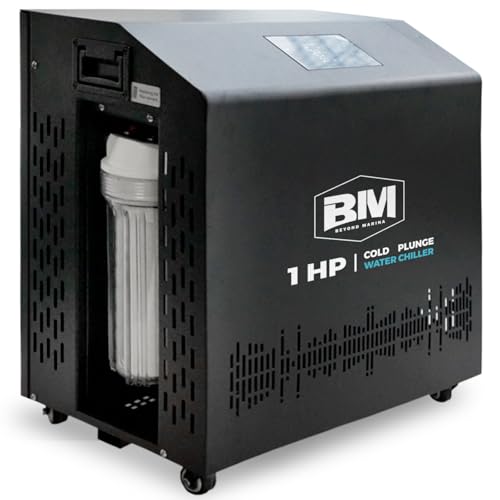
- Dual-Mode Performance with Cooling and Heating: The 1HP Ice Bath Chiller provides dual-mode functionality, allowing you to both co…
- Smart WiFi Temperature Control: Take control of your ice plunge chiller from anywhere with the built-in WiFi smart control. Connec…
- Noise Reduction for Quiet Operation: The ice bath water chiller operates quietly, with a noise level of <65dB. This low noise outp…
Healcryo 1HP Pro Chiller
Healcryo lists 8,000 BTU/h of capacity for tubs up to 120 gallons, with cooling, heating and automatic modes. The title gives a range of 37.4°F to 104°F, while one feature line says 35–104°F, so confirm the true low end with the seller. It runs on 110V, has an IPX4 rating with a UV-resistant shell, and includes ozone and 20-micron filtration.
The winter-relevant detail: the listing mentions a bottom drain port so you can fully empty the unit’s internal water before winter storage to prevent freeze damage. It also mentions auto-defrost to protect the compressor in freezing conditions, and lists a maximum ambient temperature (113°F) but not a minimum, which is the number cold-climate buyers need.
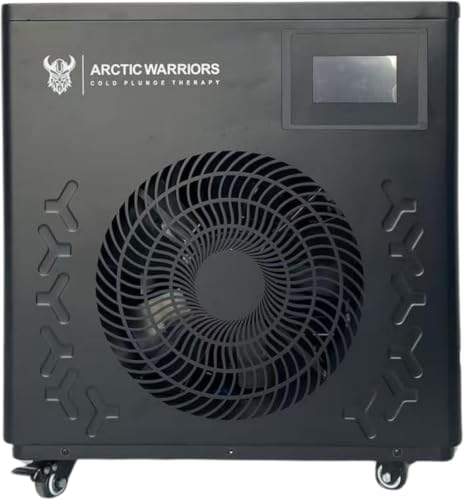
- AQUAPURE OZONE & 20-MICRON FILTRATION The AquaPure water clarity protocol combines an active ozone module with 20-micron filtratio…
- SMART WIFI APP + TOUCHSCREEN CONTROL Command your recovery from anywhere via the Smart Life app over 2.4 GHz Wi-Fi, or use the vib…
- IPX4 ALL-WEATHER OUTDOOR BUILD With an IPX4 rating and UV-resistant shell, the reinforced chassis withstands sun, rain, and temper…
GALUBUBU 1HP Heating and Cooling Chiller
A 1HP unit with an 88W circulation pump, insulated hoses (about 1.5 m each), a 5W ozone module, Wi-Fi control and hot/cold modes. The listing describes it as suitable for indoor and outdoor use with ABS housing and plugs into a standard 110V/60Hz outlet. The title mentions 260 gallons while a feature line says up to 230 gallons, so plan around the lower figure. The listing doesn’t publish a minimum outdoor temperature for heating.

- PROFESSIONAL-GRADE OZONE WATER CLARIFIER Maintain cleaner, fresher water with the dedicated 5W . This Ice Bath Water Chiller with …
- INTUITIVE WI-FI & VOICE COMPATIBLE CONTROL Beyond standard remote control, this Cold Plunge Chiller supports voice assistants (/) …
- FAST COOLING TO 3°C & PRECISE THERMOSTAT Achieve quickly thanks to the high-efficiency R410a and 2800W cooling capacity. This Cold…
Don’t skip the lid
For a 100-gallon oval stock tank, the Polar Protector hard cover uses EPS foam insulation with a six-point hook-and-buckle attachment system, and the listing gives its size as 32 x 52.5 inches and asks you to measure your tank first. Strapping matters in winter: wind gets under loose lids, and a lid that blows off overnight lets the surface freeze.

- Superior Insulation: Our EPS insulated foam hard cover is engineered to provide exceptional insulation for your 100-gallon rubber …
- Secure Attachment System: Featuring a 6-point attachment system with hooks and tightening buckles, our hard cover offers a secure …
- Debris Protection: In addition to insulation benefits, our hard cover serves as a barrier against leaves, bugs, and debris, keepin…
For more choices by tub type, see our guide to cold plunge tub covers and insulated lids.
How to choose a winter setup
- Start with your coldest normal week, not your average. If your nights regularly drop well below 25°F, assume a heat-pump chiller may not hold your set temperature and plan for a cover, circulation and a drain-down fallback.
- Look for a stated minimum ambient temperature. If a listing or manual doesn’t give one for heating mode, ask the seller in writing before you rely on it outdoors.
- Check that the drain is easy to reach. A drain port you can open in the cold, without tools, makes winterizing a five-minute job instead of a project.
- Plan for power cuts. Circulation and heating both stop when the power goes out. A Wi-Fi or app-connected unit that alerts you when it goes offline gives you time to drain or cover it.
- Match the tub to the season. Rigid insulated tubs handle winter better than thin-walled or inflatable ones. If you have an inflatable, check the manual’s minimum temperature and consider moving it into a garage. Our chiller troubleshooting guide covers what to check if cold weather makes a unit behave oddly.
How to winterize if you’re shutting down
- Switch the chiller and pump off and unplug them before touching any fittings.
- Drain the tub following the manufacturer’s instructions, then drain the chiller through its drain port and disconnect the hoses so they can empty fully.
- Remove filter cartridges, let them dry, and store them indoors.
- Store the chiller where the manual says it can be stored. If it says indoors, keep it indoors.
- Cover the empty tub so snow and meltwater don’t collect in it.
Winter safety: the part that matters most
- Talk to your doctor first if you have a heart condition, high or low blood pressure, Raynaud’s, diabetes with reduced feeling in your hands or feet, a history of stroke, or are pregnant, or if you take medication that affects your heart rate or blood pressure.
- Never plunge alone. Sudden immersion in cold water triggers the cold shock response: an involuntary gasp followed by rapid breathing and a jump in heart rate. The National Center for Cold Water Safety describes it as a reflex you can’t control by willpower. Some small studies suggest the response becomes less intense with repeated exposure, but that doesn’t make it safe to be alone. Have someone within arm’s reach.
- Ice on the surface means the water is near freezing. That is noticeably colder than the high-30s floor most chillers hold. Keep sessions short, enter slowly, keep your head and face out of the water, and get out at the first sign of numbness, shivering you can’t control, or confusion.
- Clear ice by hand or with a plastic scoop. Never chip at ice with sharp metal tools near a liner or inflatable wall, and never pour boiling water into a tub.
- Nothing electrical goes into water you’re sitting in. Livestock tank de-icers, aquarium heaters and similar devices are not designed for a tub people get into. Use equipment made for cold plunges and follow its manual.
- GFCI protection, every time. Plug chillers and pumps into a GFCI-protected, outdoor-rated outlet with a weatherproof in-use cover. Avoid extension cords unless the manual specifically allows one. A new outdoor circuit, or any 240V or hardwired equipment, is a job for a licensed electrician.
- Make the exit as safe as the entry. Have a non-slip mat, a robe and dry warm layers ready before you get in. Your body temperature can keep dropping for a while after you get out (often called afterdrop), so rewarm with dry clothing and shelter rather than standing around in the wind. Our winter cold plunge gear guide covers gloves, socks, mats and wireless thermometers.
Frequently asked questions
Will my outdoor cold plunge freeze overnight?
It depends on air temperature, wind, tub insulation and whether the water is moving. A covered, insulated tub with circulating water can ride out typical cold nights, while an uncovered, still tub can form a surface skin of ice in a single cold night.
How do I keep a stock tank cold plunge from freezing?
Use a strapped-down insulated cover, keep a pump circulating if you have one, and skim thin ice by hand before use. For long sub-freezing periods without a cold-rated chiller, many owners drain the tub or move it into a garage. Don’t put livestock de-icers or other heaters in water that people get into.
Is it safe to cold plunge when there is ice on the water?
Near-freezing water is a big step colder than typical home plunge temperatures, so the risks go up. If your doctor has cleared you, keep sessions short, never go alone, keep your head out of the water, and have warm, dry layers within reach. If you’re new to cold plunging, wait until you’re used to warmer water before trying it.


Leave a Reply